What Success Looks Like When Government Priorities Change
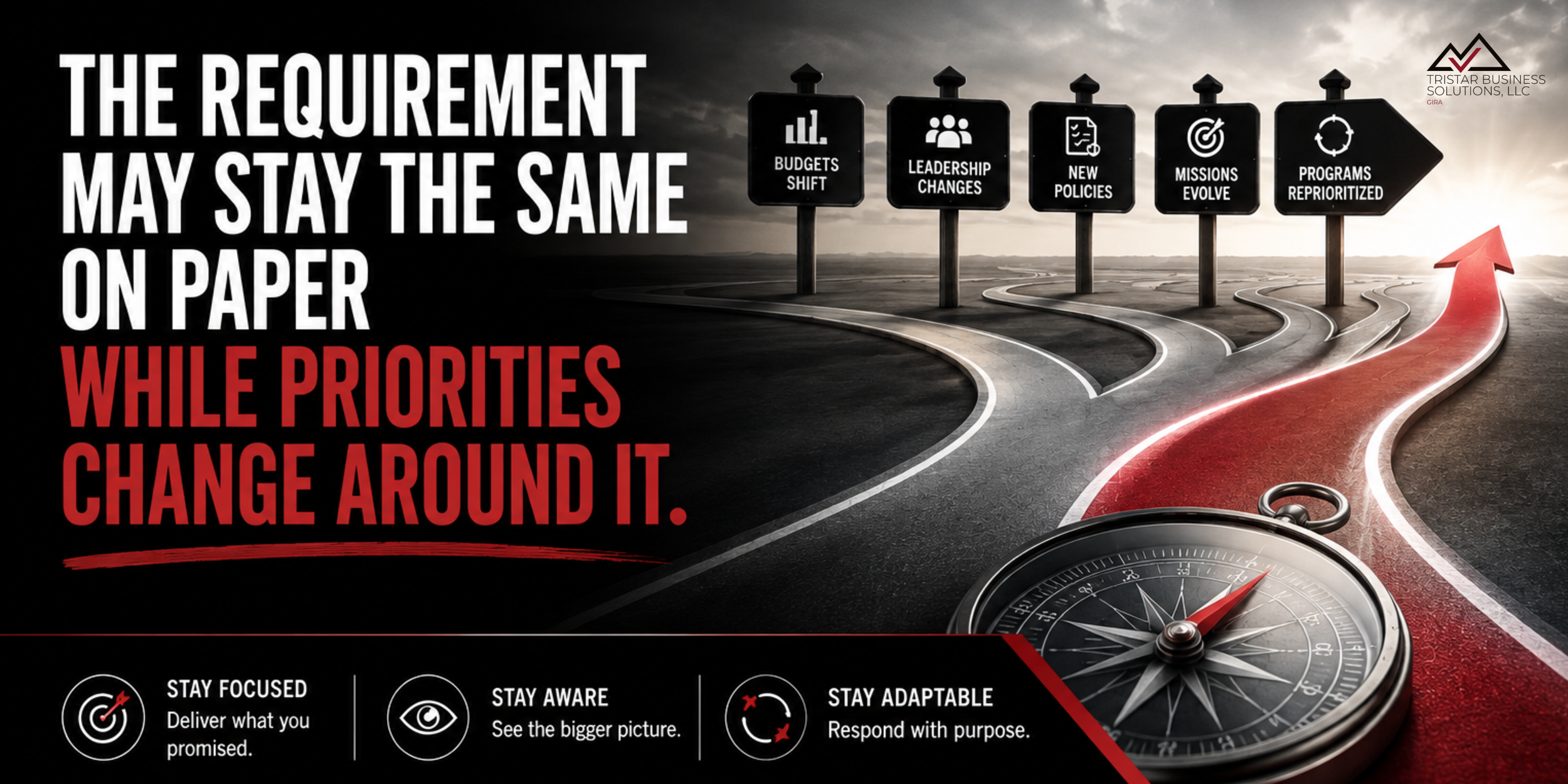
The requirement may stay the same on paper while the agency’s priorities change around it.
Government contractors work in an environment where change is normal.
Budgets shift. Leadership changes. New policies emerge. Missions evolve. Programs are reprioritized. An initiative that received significant attention six months ago may suddenly compete with a completely different set of needs.
For contractors, the challenge is not simply responding to change.
It is recognizing change early enough to respond well.
Successful contractors remain focused on their contractual responsibilities while staying aware of the broader environment surrounding the work.
That balance—between consistency and adaptability—is where strong partnerships are built.
The Contract Is Only Part of the Picture
A statement of work defines what a contractor is responsible for delivering.
But it does not always tell you everything happening inside the agency.
Program teams may be dealing with new leadership expectations, changing funding levels, emerging mission requirements, or shifting operational pressures.
A contractor focused exclusively on completing tasks can miss that bigger picture.
Strong contractors understand both:
What does the contract require?
and
What is the agency trying to accomplish?
That second question becomes especially important when priorities begin to change.
Pay Attention Before Change Becomes Urgent
Agencies rarely change direction overnight without signals.
Those signals may appear through budget discussions, procurement forecasts, leadership communication, policy changes, industry engagement, or conversations with program stakeholders.
Contractors should pay attention to those signals without jumping to conclusions.
The objective is not to predict every change.
It is to maintain enough awareness that your team is not surprised when priorities shift.
That may mean monitoring:
Agency strategic plans and public priorities
Budget developments
Procurement forecasts
Leadership changes
Policy and regulatory developments
Customer feedback
Changes in program needs
Awareness creates time to prepare.
Adapt Without Losing Focus
Being adaptable does not mean changing direction every time something new appears.
It means understanding which changes actually matter to the work.
Strong contractors ask:
Does this affect the agency's desired outcome?
Does it change how the customer defines success?
Could it affect schedule, staffing, resources, or delivery?
Is there a risk we should address now?
Does the agency need something different from our team?
Sometimes the right response is a significant operational adjustment.
Other times, it is simply better communication.
The key is responding deliberately rather than reactively.
Communication Becomes More Important During Change
When priorities are stable, established processes can carry much of the relationship.
When priorities change, communication becomes critical.
Contractors should not assume they understand what a new direction means for the customer.
Ask questions.
Confirm expectations.
Discuss potential impacts.
And when appropriate, bring solutions rather than simply identifying problems.
A useful conversation is not:
"We noticed things are changing. What should we do?"
A stronger approach is:
"We see how this change may affect these areas. Here are the options we've identified, and we'd like to make sure we're aligned with your priorities."
That is the difference between reacting to change and helping the customer navigate it.
Operational Flexibility Matters
Companies that struggle with changing priorities often have rigid internal systems.
A staffing change becomes difficult. A new reporting request creates disruption. A shift in schedule affects several departments.
Strong contractors build enough operational flexibility to respond without creating unnecessary chaos.
That includes having:
Clear internal ownership
Strong documentation
Cross-functional communication
Visibility into resources and capacity
Defined escalation processes
Adaptability is much easier when the organization behind the contract is well managed.
Don't Confuse Adaptability With Scope Creep
There is also an important boundary.
Supporting changing agency priorities does not mean informally accepting work outside the contract.
Contractors still need to understand contractual scope, authorization, funding, and modification requirements.
Being a good partner means helping the agency navigate change responsibly—not creating compliance or performance problems by agreeing to everything.
Strong relationships depend on both flexibility and discipline.
Change Can Reveal New Opportunities
Changing priorities are not always a threat.
They can reveal where agencies are heading next.
A contractor that understands an evolving mission may identify:
New capability needs
Adjacent requirements
Future acquisition opportunities
Partnership opportunities
Areas where additional expertise will be needed
That intelligence can inform capture planning and long-term growth.
But opportunity should come second.
The first responsibility is helping the customer succeed with the work already entrusted to you.
What Success Looks Like
When government priorities change, successful contractors:
Stay informed without chasing every new development
Understand the agency's mission beyond the immediate task
Communicate early when changes may affect performance
Bring solutions, not just concerns
Maintain operational flexibility
Protect contractual and compliance boundaries
Continue delivering reliably while the environment evolves
The goal is not to resist change.
It is to remain dependable through it.
Final Thought
Government priorities will change.
Strong contractors expect that.
They stay close enough to the mission to recognize meaningful changes, disciplined enough to protect performance, and flexible enough to adjust when the customer genuinely needs something different.
When priorities change, agencies don't just need contractors who can keep up. They need partners they can continue to rely on.