Winning the contract gets attention. How you perform after the award determines what happens next.
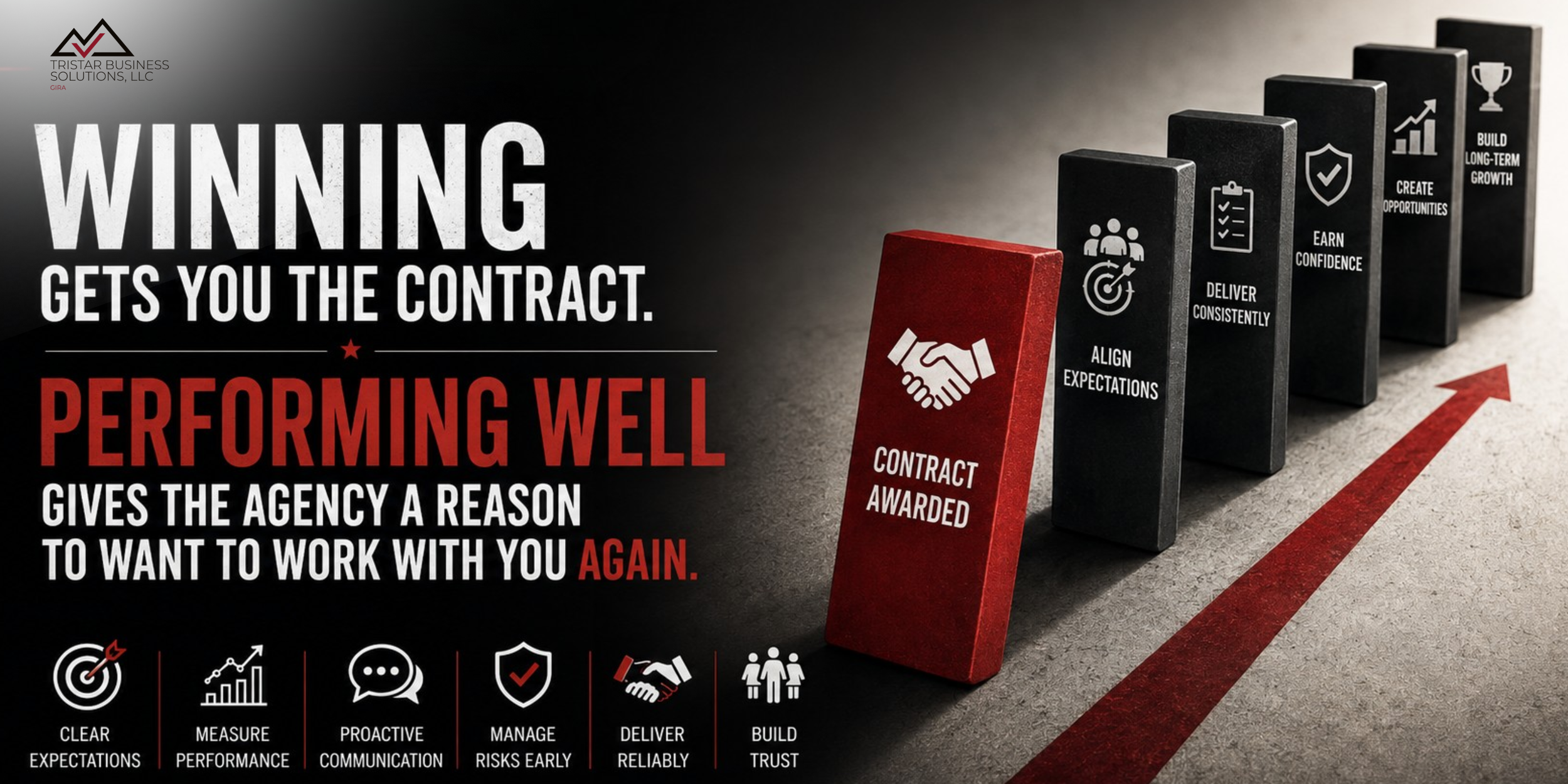
A contract award is worth celebrating. Months of positioning, relationship-building, capture work, and proposal development have finally produced a result.
But the award is not the finish line.
It is the point where expectations become measurable.
Once performance begins, the agency is no longer evaluating what your company says it can do. It is experiencing how your company actually operates.
Do you deliver what you promised? Do you communicate clearly? Do you catch problems early? Can the agency rely on your team without constantly following up?
Those experiences shape more than the success of the current contract. They can influence past performance, future opportunities, recompetes, renewals, and the reputation your company builds across the federal marketplace.
That is why strong contract performance management matters.
Success Starts With Clear Expectations
Strong performance begins with understanding exactly what success means to the customer.
The contract establishes requirements, but effective contractors go further. They make sure their teams understand the deliverables, schedules, performance standards, reporting requirements, responsibilities, and communication expectations attached to the work.
That alignment should happen early.
When expectations are unclear internally, small misunderstandings can turn into missed deadlines, inconsistent deliverables, or unnecessary friction with the customer.
The goal is simple: everyone responsible for delivery should know what is expected, when it is expected, and how success will be measured.
Measure Performance Before Someone Else Has To
Contract performance should never be something a contractor discovers during a formal review.
Strong contractors know where they stand throughout the engagement.
Depending on the contract, that may mean monitoring:
Deliverable quality and timeliness
Key performance indicators
Service levels
Milestones
Staffing commitments
Customer feedback
Corrective actions
Schedule and budget performance
The specific metrics will vary, but the principle remains the same.
Measure what matters and monitor it consistently.
Good performance management creates visibility. Instead of assuming everything is going well, leadership has the information needed to confirm it—or intervene when it isn't.
Documentation Protects the Relationship
Good work matters.
Being able to demonstrate that good work matters too.
Documentation creates a clear record of performance, decisions, approvals, changes, challenges, and outcomes throughout the contract lifecycle.
That can include status reports, meeting notes, deliverable records, performance data, correspondence, issue logs, and other contract-specific documentation.
This isn't paperwork for the sake of paperwork.
Strong documentation helps teams maintain continuity, supports accountability, reduces misunderstandings, and provides evidence of performance when questions arise.
It also becomes valuable when preparing for future opportunities and demonstrating relevant past performance.
Communicate Before the Customer Has to Ask
One of the clearest signs of strong contract management is proactive communication.
Agencies should not have to repeatedly ask:
"Where does this stand?"
Strong contractors provide visibility before uncertainty develops.
They communicate progress. They confirm important decisions. They raise concerns early. And when something changes, they explain both the impact and the plan for addressing it.
That doesn't mean overwhelming the customer with unnecessary updates.
It means communicating the right information at the right time.
The objective is confidence.
Your customer should understand where things stand and trust that your team has control of the work.
Identify Problems While They Are Still Small
No contract runs perfectly.
Schedules change. Staffing issues occur. Requirements evolve. Dependencies create delays. Unexpected challenges appear.
The difference between strong and weak performance often isn't whether problems occur.
It's how quickly they're identified and managed.
Waiting until a small problem becomes a missed deliverable limits everyone's options.
Strong contractors identify risks early, communicate them appropriately, determine corrective action, and follow through.
That demonstrates something agencies value enormously: reliability under pressure.
Stay Aligned With the Agency
Contractors can become so focused on completing individual tasks that they lose sight of why the work exists in the first place.
The strongest teams continue connecting contract performance to the agency's mission and priorities.
Ask:
Are we delivering the outcome the customer actually needs?
Are priorities changing?
Are there emerging concerns we should understand?
Are we making the agency's work easier—or creating additional work for them?
Contract requirements matter, but so does the experience of working with your organization.
Contractors who understand both tend to build stronger partnerships.
Performance Today Shapes Opportunity Tomorrow
Strong contract performance creates something that is difficult to manufacture through marketing alone:
credibility.
A record of successful delivery can strengthen past performance, support future proposals, deepen agency relationships, and improve your company's position for recompetes and adjacent opportunities.
Poor performance can do exactly the opposite.
That's why contract performance management should not be treated simply as an administrative responsibility after the "real work" of winning is finished.
It is part of the growth strategy.
What Success Looks Like
Successful contract performance management isn't complicated in theory.
It looks like:
Expectations understood from the beginning
Performance measured consistently
Documentation kept current
Communication happening proactively
Problems identified before they escalate
Teams remaining aligned with agency expectations
Commitments being delivered reliably
None of these actions alone creates a strong contractor.
Repeated consistently, they build trust.
Final Thought
Winning a federal contract proves that an agency was willing to give your company an opportunity.
Performance determines what you do with it.
The contractors that create long-term success don't disappear after award and simply work toward the next solicitation. They treat delivery as part of their reputation, their relationship strategy, and their future pipeline.
Winning gets you the contract. Performing well gives the agency a reason to want to work with you again.